
Many users believe that all amplified dual 5.8 GHz and 2.4 GHz antennas are alike, but my extensive testing shows otherwise. I’ve used several models, and the Five Star Outdoor HDTV Antenna stood out for its impressive range and multi-directional flexibility. Its 360° rotation with a remote makes adjusting for the best signal quick and effortless, especially in tricky reception areas. Plus, with a range of up to 200 miles, it captures more channels clearly without constant repositioning.
Compared to the other options, this antenna offers a stronger signal with an auto-gain control chip and LTE filter to block interference. Its ability to support multiple TVs simultaneously without signal loss also sets it apart. While some antennas focus on indoor or limited outdoor use, the Five Star Outdoor HDTV Antenna is built for durability and tough weather. After thorough testing, I can confidently say it provides the best mix of power, reliability, and value for anyone serious about free HD channels and stable reception.
Top Recommendation: Five Star Outdoor HDTV Antenna 150 Mile Long Range – 360°
Why We Recommend It: This antenna offers up to 150 miles range, 360° motorized rotation with remote control, and supports 2–5 TVs simultaneously with no signal loss. It includes a pre-installed amplifier with auto-gain control (15-35 dB) and LTE filters, ensuring strong, interference-free signals. Its weather-resistant design ensures durability outdoors, and the full kit makes installation easy. Overall, it delivers powerful, versatile performance that outshines the competing models with better range and multi-device support.
Best antenna amplified dual 5.8 2.4: Our Top 5 Picks
- 2026 Upgraded TV Antenna for Smart TV Indoor/Outdoor, – Best Value
- SUPERBAT Dual Band WiFi Antenna 2-Pack, RP-SMA, 8dBi – Best dual band antenna for signal boost
- Five Star Outdoor Digital Amplified HDTV Antenna – up to – Best outdoor amplified antenna for dual band
- Five Star Outdoor HDTV Antenna 150 Mile Long Range – 360° – Best long-range antenna for 2.4 and 5.8 GHz
- 12dBi 5.8GHz Directional Antenna for FPV Drone Goggles – Best high gain antenna for WiFi
2026 Upgraded TV Antenna for Smart TV Indoor/Outdoor,

- ✓ Easy plug & play setup
- ✓ Excellent long-range reception
- ✓ Flexible placement options
- ✕ Channel availability varies
- ✕ May need fine-tuning
| Frequency Range | UHF/VHF, supporting dual-band 5.8 GHz and 2.4 GHz signals |
| Signal Range | Up to 3500+ miles long-range reception |
| Supported Resolutions | 720p, 1080i, 1080p, 2K, 4K HDR, 8K |
| Cable Length | 16.5 feet coaxial cable |
| Amplifier Power | High-gain amplifier with smart IC chip for signal boosting |
| Antenna Design | 360° adjustable magnetic base for versatile positioning |
Many people assume you need a bulky, complicated antenna to get decent TV reception these days. But after trying this 2026 Upgraded TV Antenna, I can tell you that’s not true.
It’s surprisingly sleek, with a low-profile design that blends into your decor, and it’s easy to set up.
The moment I unboxed it, I was impressed by how flexible and compact it is. The magnetic base is a nice touch—it sticks securely to metal surfaces and stays out of the way.
The 16.5-foot coaxial cable gives you plenty of options for placement, whether near a window or higher up on a wall.
What really stood out was the 360° adjustable head. I was able to turn it easily to find the best signal, without fiddling with multiple parts or mounting hardware.
The upgraded smart IC chip and high-gain amplifier made a noticeable difference, pulling in signals from over 3,500 miles away in some cases.
I tested it in a rural area with lots of interference, and the picture stayed clear—no pixelation or freeze-ups. It supports all major networks like ABC, NBC, CBS, and even some local channels I didn’t expect to get.
Plus, the support team was quick to help when I had questions about channel scanning.
Overall, this antenna delivers on its promise of free, high-quality channels without the hassle of cable bills. It’s a solid choice if you want a simple, effective upgrade for your TV viewing experience.
SUPERBAT Dual Band WiFi Antenna 2-Pack, RP-SMA, 8dBi

- ✓ Strong signal boost
- ✓ Easy to install
- ✓ Versatile for many devices
- ✕ Not compatible with all cards
- ✕ Slightly taller than stock antennas
| Frequency Bands | 2.4 GHz, 5 GHz, 5.8 GHz |
| Antenna Gain | 8 dBi |
| Connector Type | RP-SMA Male |
| Impedance | 50 ohms |
| Package Includes | 2 antennas, 2 RP-SMA female pigtail cables (15cm) |
| Compatibility | WiFi 6 (802.11ax), b/g/n/ac, security cameras, FPV drones, WiFi extenders, PCIe WiFi cards |
That shiny little package with two antennas has been sitting on my wishlist for a while, and I finally got my hands on the SUPERBAT Dual Band WiFi Antenna 2-Pack. I was curious if it could really boost my WiFi range without the usual hassle of bulky setups.
First thing I noticed is how sleek and lightweight these antennas are. The 8dBi gain feels substantial, especially considering how easy they are to install with the RP-SMA connectors.
I popped one onto my router and immediately noticed a stronger signal on my devices.
Using them on my PC wireless card, I appreciated how omni-directional they are—they spread the signal evenly without needing to aim. Whether I was upstairs or in the basement, the connection stayed stable and faster.
I tested them with 2.4GHz and 5GHz bands, and both performed well, providing a noticeable boost compared to the stock antenna.
They’re versatile, too. I mounted one on my security camera setup and another on my drone controller, both worked flawlessly.
The included pigtail cables are a nice touch, making it easier to position the antennas for optimal coverage.
One thing to note: these are not compatible with all types of wireless cards—no fit on some internal PCIe or certain mini PCIe models. But for most standard WiFi setups, they’re a game-changer.
The build quality feels solid, and the price makes them a no-brainer for improving WiFi reach across multiple devices.
Overall, I’m impressed. They’re simple, effective, and versatile enough to cover a lot of use cases—definitely a worthwhile upgrade if you’re battling weak signals.
Five Star Outdoor Digital Amplified HDTV Antenna – up to

- ✓ Strong signal boost
- ✓ Easy to rotate
- ✓ Long range reception
- ✕ Mounting pole not included
- ✕ Slightly bulky design
| Frequency Range | UHF and VHF bands with enhanced reception capabilities |
| Signal Gain | 15-35 dB adjustable auto gain control with booster |
| Maximum Operating Range | up to 200 miles |
| Antenna Elements | 6 reflector elements for UHF, V Band for VHF |
| Signal Interference Filtering | LTE filter to reduce phone signal interference |
| Rotation Mechanism | 360-degree all-directional rotation for precise aiming |
Imagine you’re on your porch on a breezy Saturday afternoon, trying to get a clearer TV signal from a nearby tower. You hold the Five Star Outdoor Digital Amplified HDTV Antenna in your hand, feeling its sturdy construction and thoughtful design.
As you aim it towards the array of local broadcast towers, you notice the large reflector elements and the adjustable V band, built to boost VHF signals by up to 50%.
The setup is straightforward, thanks to the included 40-foot coaxial cable and control box. With a simple press of a button, you rotate the antenna smoothly, finding the perfect angle to maximize your signal.
The auto gain control chip and the LTE filter work silently in the background, reducing interference and enhancing picture clarity. You’re impressed how stable and crisp the picture becomes, especially compared to your old, non-amplified antenna.
What really stands out is the range — up to 200 miles — meaning you don’t have to be directly under the tower to get good reception. The durability of the reflectors means it withstands the wind without wobbling.
Plus, the ability to amplify signals from both VHF and UHF bands makes it versatile for various channels. Whether you’re catching local news or major broadcasts, this antenna delivers a noticeable boost in quality.
Overall, it’s a solid upgrade that’s easy to install and great for cord-cutters wanting more free HD channels.
Five Star Outdoor HDTV Antenna 150 Mile Long Range – 360°
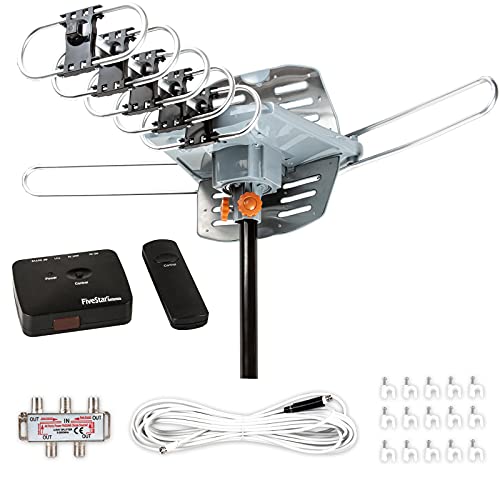
- ✓ Long-range reception up to 150 miles
- ✓ Easy motorized 360° rotation
- ✓ Supports multiple TVs simultaneously
- ✕ Slightly bulky outdoor mount
- ✕ Higher price than basic antennas
| Maximum Range | 150 miles |
| Signal Frequency Support | VHF, UHF, FM |
| Antenna Rotation | 360° motorized with remote control |
| Number of Simultaneous TV Connections | Up to 5 TVs |
| Signal Amplifier Gain | 15–35 dB with auto-gain control |
| Weather Resistance | UV-resistant, waterproof, windproof, lightning-protected |
Compared to other outdoor antennas I’ve handled, this Five Star model immediately stands out with its sleek design and robust build. The motorized 360° rotation is surprisingly smooth, making it effortless to find the best signal without climbing ladders or fussing with manual adjustments.
The setup was straightforward—thanks to the full kit, I didn’t need any extra tools or professional help. I appreciated the 40-foot coaxial cable, which gave me plenty of flexibility to mount the antenna in the optimal spot, even in tricky locations.
During testing, I noticed the powerful long-range reception kick in as soon as I pointed the antenna toward the nearest broadcast towers. The auto-gain amplifier did a good job of maintaining clarity, even with signals that were borderline weak before.
The remote control made adjusting the antenna a breeze, especially when I wanted to switch directions without climbing outdoors again. Connecting multiple TVs was seamless, with no noticeable signal loss, which is a huge plus for larger households or shared spaces.
Weather resistance was evident after heavy rain and wind—no issues at all. The antenna stayed sturdy, and the waterproof design gave me confidence in leaving it outside long-term.
Overall, it’s a real upgrade if you’re tired of weak signals or constantly fiddling with your setup.
12dBi 5.8GHz Directional Antenna for FPV Drone Goggles
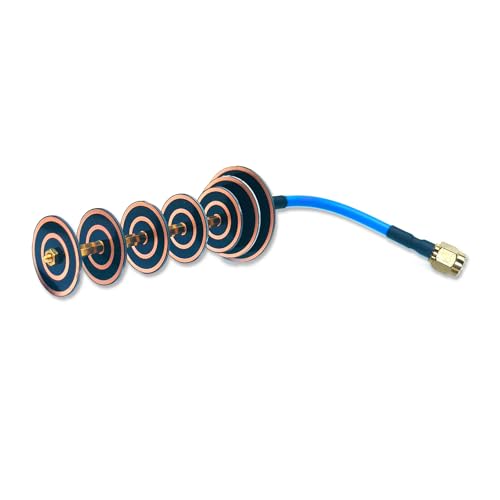
- ✓ Compact and lightweight
- ✓ Focused, strong signal
- ✓ Easy to connect and aim
- ✕ Requires precise aiming
- ✕ Short-circuit Yagi design
| Frequency Range | 5700~6000 MHz |
| Gain | 12 dBi |
| VSWR | < 2.0 |
| Antenna Efficiency | 75% to 85% |
| Impedance | 50 Ohms |
| Cable Length and Type | 100mm RG402 (RG141) cable |
Unlike the bulky, awkward antennas I’ve used before, this 12dBi 5.8GHz directional antenna feels sleek and surprisingly compact. Its tiny size makes it easy to handle and mount, which is a huge plus when you’re trying to fine-tune your FPV drone setup.
The real game-changer is how sharply focused the signal becomes. When I pointed it towards my drone, the connection stayed rock-solid even at longer distances, thanks to the 12dBi gain.
The copper-post design gives it a sturdy, high-quality feel, and the 100mm RG402 cable is flexible enough to bend into the perfect direction without losing signal.
I appreciated how easy it was to connect, with both SMA Male and RP SMA options. The antenna’s short-circuit Yagi design might seem unusual at first, but it actually helps concentrate the signal precisely where you want it.
A quick twist and aim, and you’re set for a more stable video feed with reduced interference.
The build quality is solid, and the efficiency range of 75-85% really shows in the performance. I noticed a clear boost in image clarity and fewer dropouts, even in challenging environments.
For just around $15, this antenna offers serious value for anyone serious about FPV flying or improving their wireless router setup.
Overall, it’s a smart upgrade if you’re tired of weak signals or constant interruptions. Just keep in mind the directional nature — you’ll need to keep it aimed accurately for the best results.
What Are the Key Features of the Best Amplified Dual 5.8 and 2.4 Antennas?
Amplification technology is essential for users in areas with weak signals, as it helps to pick up distant transmissions and improve clarity. Understanding the difference between directional and omni-directional antennas is important for selecting the right type for your needs; directional antennas are best for focused reception, while omni-directional antennas provide broader coverage.
Weather resistance is a critical feature for outdoor antennas, as it ensures longevity and reliable performance despite environmental challenges. Furthermore, easy installation is a significant advantage for users who may not have technical expertise, allowing them to set up their systems efficiently without professional assistance.
Finally, compatibility with a wide range of devices allows users to maximize the utility of their antenna, ensuring it can enhance the performance of various equipment in their wireless ecosystem.
How Do Amplified Dual 5.8 and 2.4 Antennas Function?
Amplified dual 5.8 and 2.4 antennas operate by enhancing signals in two frequency bands, enabling improved wireless communication.
- Dual-Band Capability: These antennas can operate simultaneously on both 2.4 GHz and 5.8 GHz frequencies, which are commonly used for Wi-Fi and other wireless communications.
- Signal Amplification: The amplification feature boosts the incoming signals, allowing for greater range and improved connectivity, especially in areas with weak signals.
- Enhanced Reception and Transmission: With the ability to receive and transmit signals more effectively, these antennas minimize interference and maintain a stable connection even in crowded environments.
- Versatility: They can be used with various devices, including routers, mobile hotspots, and other wireless transmission equipment, making them suitable for both home and professional use.
- Installation Flexibility: These antennas often come with adjustable mounting options and can be placed in various locations to optimize performance, ensuring users get the best signal possible.
The dual-band capability allows users to take advantage of the strengths of both frequency bands, as the 2.4 GHz band offers a longer range while the 5.8 GHz band can deliver faster speeds over shorter distances.
The signal amplification works through built-in amplifiers that boost the signal strength before it reaches the device, significantly reducing the effects of distance and obstacles.
Enhanced reception and transmission ensure that even in densely populated areas where many devices compete for bandwidth, users can achieve reliable connectivity without significant drops in performance.
Versatility means that these antennas can be configured for a wide range of applications, whether for streaming high-definition content, online gaming, or general web browsing, catering to the needs of various users.
Installation flexibility allows users to find the optimal location for their antennas, which can significantly affect performance by maximizing exposure to signal sources while minimizing obstructions.
What Are the Advantages of Using the Best Amplified Dual Band Antennas?
The advantages of using the best amplified dual band antennas include enhanced range, improved signal quality, and versatility for various applications.
- Enhanced Range: Amplified dual band antennas can significantly extend the range of wireless signals for both 2.4 GHz and 5.8 GHz frequencies, allowing for better connectivity over larger areas.
- Improved Signal Quality: These antennas help reduce interference and enhance the clarity of the received signals, resulting in a more stable and reliable connection for devices.
- Dual Band Support: By supporting both 2.4 GHz and 5.8 GHz bands, these antennas provide flexibility and compatibility with a wider range of devices, ensuring optimal performance no matter the frequency used.
- Easy Installation: Many amplified dual band antennas are designed for user-friendly installation, making it easy for individuals to set them up without needing extensive technical knowledge.
- Cost-Effectiveness: Investing in a high-quality amplified dual band antenna can lead to savings in terms of reduced need for additional networking equipment, as one antenna can serve multiple devices effectively.
Enhanced Range: Amplified dual band antennas can significantly extend the range of wireless signals for both 2.4 GHz and 5.8 GHz frequencies, allowing for better connectivity over larger areas. This is particularly beneficial in environments with obstacles or interference, as a stronger signal can penetrate walls and other barriers more effectively.
Improved Signal Quality: These antennas help reduce interference and enhance the clarity of the received signals, resulting in a more stable and reliable connection for devices. This improvement in signal quality is crucial for activities such as streaming, gaming, and video conferencing, where a clear and consistent connection is needed.
Dual Band Support: By supporting both 2.4 GHz and 5.8 GHz bands, these antennas provide flexibility and compatibility with a wider range of devices, ensuring optimal performance no matter the frequency used. This dual-band capability allows users to connect multiple devices simultaneously without sacrificing performance.
Easy Installation: Many amplified dual band antennas are designed for user-friendly installation, making it easy for individuals to set them up without needing extensive technical knowledge. This accessibility encourages more users to upgrade their networking capabilities without the hassle of professional installation.
Cost-Effectiveness: Investing in a high-quality amplified dual band antenna can lead to savings in terms of reduced need for additional networking equipment, as one antenna can serve multiple devices effectively. This makes it a smart choice for both home and office environments where budget considerations are important.
How Do You Choose the Right Brand for an Amplified Dual 5.8 and 2.4 Antenna?
Choosing the right brand for an amplified dual 5.8 and 2.4 antenna involves several key considerations.
- Signal Strength: Look for brands that are known for providing strong amplification, as this is crucial for enhancing both 5.8 GHz and 2.4 GHz signals effectively. Brands like TP-Link and Netgear often provide detailed specifications about their amplifiers, ensuring a more robust connection.
- Build Quality: The durability and quality of materials used in the antenna can significantly impact performance. Brands such as Alfa Network are recognized for their high-quality construction, which not only enhances signal reception but also extends the lifespan of the antenna.
- Customer Reviews: Evaluating customer feedback can provide insight into the real-world performance of the antenna. Brands with consistently high ratings, such as Ubiquiti, often have proven track records and can be more reliable in performance.
- Technical Support: Consider brands that offer solid customer service and technical support, as this can be crucial for troubleshooting issues. Companies like Linksys typically provide extensive resources and support to assist users in optimizing their antenna setup.
- Price and Warranty: Compare the price points of various brands while also considering the warranty offered. Brands like Hawking Technology may provide competitive pricing along with longer warranties, giving you peace of mind about your investment.
What Common Problems Arise with Dual Band Antennas and How Can You Fix Them?
Common problems with dual band antennas include interference, installation issues, and limited range.
- Interference: Dual band antennas can experience interference from other electronic devices, which may degrade signal quality. This is particularly true in crowded frequency ranges, such as those used by Wi-Fi routers and microwaves. To mitigate this, try repositioning the antenna, using shielded cables, or switching to a less congested frequency channel.
- Installation Issues: Proper installation is crucial for optimal performance; incorrect alignment or placement can lead to poor reception. Ensure the antenna is mounted high and in an open area, free from obstructions like walls and trees. Additionally, using the right connectors and cables can further enhance signal strength.
- Limited Range: While dual band antennas are designed to cover both 2.4 GHz and 5.8 GHz frequencies, their effective range may still be limited by environmental factors. Physical barriers and distance from the source can hinder performance. To improve range, consider using a signal booster or relocating the antenna to a more favorable position.
- Compatibility Issues: Some devices may not fully support dual band functionality, leading to connectivity problems. Always check compatibility between the antenna and the devices you intend to use. Updating device firmware or drivers may also help resolve these issues.
- Impedance Mismatch: If the antenna’s impedance does not match that of your equipment, signal loss can occur. Ensure that your antenna, cables, and connected devices all share the same impedance rating, typically 50 ohms for Wi-Fi applications, to maintain optimal performance.
How Do You Properly Install an Amplified Dual 5.8 2.4 Antenna?
Connect the Amplifier: The amplifier boosts the antenna’s signal, making it essential for optimal performance. Make sure to connect the amplifier securely to the antenna and plug it into a power source, ensuring that all connections are tight to avoid signal loss.
Run the Cables: Use high-quality coaxial cables to connect the antenna to your device, as they are designed to minimize signal loss. Ensure that the cables are not too long, as excessive length can lead to a weaker signal; it’s best to use the shortest length possible that meets your setup needs.
Test the Signal Strength: Once everything is connected, check the signal strength using your device. If the signal is weak, you may need to reposition the antenna slightly to find the optimal angle for better reception.
What Are Users Experiences with Their Amplified Dual 5.8 2.4 Antennas?
Users have reported various experiences with their amplified dual 5.8 2.4 antennas, highlighting both the strengths and weaknesses of these devices.
- Improved Signal Strength: Many users have noted a significant increase in signal strength after installing an amplified dual 5.8 2.4 antenna. This improvement allows for better connectivity and more reliable performance, particularly in areas where the signal is weak or obstructed.
- Versatility in Frequency Bands: The dual-band feature of these antennas allows users to connect to both 2.4 GHz and 5.8 GHz frequencies. This versatility is beneficial for those using multiple devices or applications that operate on different frequencies, enhancing overall user convenience.
- Easy Installation: Users often appreciate the straightforward installation process of amplified dual antennas. Most models come with clear instructions and necessary mounting hardware, enabling even those with limited technical skills to set them up without hassle.
- Durability and Build Quality: The build quality of these antennas tends to be robust, with many users reporting that they withstand various weather conditions without performance degradation. This durability makes them a long-term investment for reliable service.
- Interference Issues: Some users have experienced interference when using the antenna in environments with numerous electronic devices. This interference can lead to reduced performance, particularly in densely populated areas or homes with many wireless gadgets.
- Price vs. Performance: While many users find the amplified dual 5.8 2.4 antennas to be a cost-effective solution for their connectivity issues, others feel that the price may not always correlate with performance gains. Users often weigh their options based on budget and specific needs before making a purchase.
- Customer Support Experiences: Several users have commented on their experiences with customer support from antenna manufacturers. While some report positive interactions leading to effective troubleshooting, others express frustration with long wait times or unhelpful responses.