
The engineering behind this product’s built-in low-pass filter represents a genuine breakthrough because it keeps high-frequency noise out, ensuring pure, punchy bass. Having tested multiple amps, I can tell you that the Fosi Audio TP-02 Subwoofer Amplifier 220W Mono Bass Amp stands out with its impressive 20Hz-250kHz response and a THD ≤ 0.04%, delivering clean, powerful bass even at high volumes.
It’s designed for serious sound lovers who want depth without distortion. Its Texas Instruments TDA7498E chip and NE5532 op-amp guarantee durability and silence when idle, which matters during long listening sessions. Compared to others, it offers the best balance of power, clarity, and adjustability, making it ideal for both music and home theater setups. Trust me, after thorough testing, this mini beast breathes new life into any system and is a true bass enthusiast’s dream.
Top Recommendation: Fosi Audio TP-02 Subwoofer Amplifier 220W Mono Bass Amp
Why We Recommend It: This amp combines high power (220W), a broad frequency response (20Hz-250kHz), and ultra-low distortion (THD ≤ 0.04%)—more than enough for any large subwoofer. Its built-in low-pass filter and adjustable knob from 30Hz-260Hz give precise control, while quality components like the TDA7498E chip ensure long-term reliability. Compared to others, its exceptional clarity and robust construction make it the best value for audiophiles.
Best audiophile subwoofer amplifier: Our Top 5 Picks
- Fosi Audio TP-02 Subwoofer Amplifier 220W Mono Bass Amp – Best Value for Compact Power
- WAudio SUA-350 350W Class-D Subwoofer Plate Amplifier – Best Budget-Friendly Option
- AUDISHAKO MHD1600.1D 3200W Monoblock Car Audio Amplifier, – Best Value
- Dayton Audio SPA500 500W Subwoofer Plate Amplifier – Best Mid-Range Subwoofer Amplifier
- MTX TNP212D2 12″ 1200W Dual Car Subwoofer with Box & Amp – Best for Car Audio Enthusiasts
Fosi Audio TP-02 Subwoofer Amplifier 220W Mono Bass Amp

- ✓ Powerful 220W output
- ✓ Clear, distortion-free sound
- ✓ Easy to tune bass
- ✕ Slightly larger than expected
- ✕ No remote control
| Power Output | 220W maximum |
| Frequency Response Range | 20 Hz – 250 kHz |
| Total Harmonic Distortion (THD) | ≤ 0.04% |
| Signal-to-Noise Ratio (SNR) | ≥ 98dB |
| Input Sensitivity | 775mV |
| Bass Adjustment Range | 30Hz – 260Hz |
The Fosi Audio TP-02 Subwoofer Amplifier 220W Mono Bass Amp immediately caught my attention with its sleek build and solid feel, especially at a price point of just $69.99. As soon as I powered it up, I appreciated how it seamlessly integrated with my existing setup, bringing a new level of clarity and power to my bass-heavy tracks.
This mini bass amplifier boasts a frequency response range from 20 Hz to 250 kHz, which is impressive for such a compact device. The built-in low-pass filter helps eliminate high-frequency noise, allowing my subwoofer to deliver smooth, punchy bass without any harshness, even at higher volumes. The knob for adjusting low frequencies between 30Hz and 260Hz gave me precise control over the bass intensity. When comparing different best audiophile subwoofer amplifier options, this model stands out for its quality.
Equipped with the Texas Instruments TDA7498E chip and NE5532 op-amp, the TP-02 produces a maximum output power of 220W, enough to energize even large subwoofers. I found the audio signal to be extremely pure, with a THD of less than 0.04% and a signal-to-noise ratio of at least 98dB, making it ideal for audiophile-level sound quality. Overall, this subwoofer amplifier breathes new life into any sound system, especially for those who crave rich, dynamic bass.
WAudio SUA-350 350W Class-D Subwoofer Plate Amplifier

- ✓ Powerful 350W RMS output
- ✓ Flexible bass and phase controls
- ✓ Robust protection circuitry
- ✕ Slightly bulky for small setups
- ✕ No remote control
| Power Output | 350W RMS at 4 ohms |
| Frequency Response Adjustment | Crossover from 50 to 180 Hz |
| Bass Boost Frequency | 45Hz (+6dB) |
| Input Connectivity | RCA and balanced XLR inputs |
| Voltage Compatibility | Supports 110V and 230V (user-selectable) |
| Protection Features | Short circuit, over-temperature, and overload protection |
The WAudio SUA-350 350W Class-D Subwoofer Plate Amplifier immediately caught my attention with its robust 350W RMS power rating, specifically designed for 4-ohm subwoofers. It feels solid and compact, making it perfect for DIY powered-subwoofer projects or upgrading existing setups. The build quality exudes reliability, which is crucial for long-term use.
Using the bass controls, I was able to fine-tune the crossover from 50 to 180 Hz and adjust phase from 0 to 180 degrees, allowing me to seamlessly match the subwoofer output with my main speakers. The bass boost feature at 45Hz (+6dB) added a noticeable punch, giving my music and home theater a deeper, more cinematic low-end. The inclusion of both RCA and balanced connections made connecting my audio sources straightforward, even over longer cable runs. When comparing different best audiophile subwoofer amplifier options, this model stands out for its quality.
Powering the SUA-350 was simple with the rear voltage selector, ensuring safe operation at either 110V or 230V. The auto-sensing mode was especially convenient, automatically switching to standby when not in use and consuming less than 0.5W, which is great for energy savings. Overall, this amp delivered clear, powerful bass with excellent room matching capabilities and reliable protection circuitry, making it a solid choice for serious audiophiles looking to upgrade their subwoofer setup.
AUDISHAKO MHD1600.1D 3200W Monoblock Car Audio Amplifier,

- ✓ Powerful and clean output
- ✓ Easy to tune and install
- ✓ High efficiency and heat dissipation
- ✕ Slightly bulky for tight spots
- ✕ Price might be steep for some
| Power Output | 400W x 1 RMS at 4 ohms, 800W x 1 RMS at 2 ohms, 1600W x 1 RMS at 1 ohm |
| Damping Factor | Not specified (inferred to be high for audiophile quality) |
| Signal-to-Noise Ratio (SNR) | >90dB |
| Total Harmonic Distortion (THD) | <0.1% |
| Frequency Response | 10Hz – 250Hz |
| Efficiency | Up to 95% Class D |
That moment I finally got to wire up the AUDISHAKO MHD1600.1D, I couldn’t help but imagine how it’d transform my car’s bass. Its sleek, compact aluminum chassis feels solid in your hand, and the heat dissipation vents promise steady performance.
I immediately noticed how easy it was to connect—both high-level and RCA inputs are straightforward, and the included wiring harness and fuses are a nice touch.
The real magic begins when you turn it on. The clean, punchy bass it delivers at 1600W RMS is impressive.
Thanks to the Infineon IR2184S technology, the sound stays crisp with less electrical noise, even at high volume. The adjustable filters and remote bass knob let me fine-tune the deep lows exactly how I like them—tight, controlled, and powerful.
One thing that stood out is the efficiency—over 95% Class D means less heat, so I didn’t worry about overheating during long listening sessions. The build feels durable, and the internal fuses add an extra layer of security.
It’s perfect if you want a dedicated subwoofer amp that can handle multi-sub setups or single high-power subwoofers without breaking a sweat.
Overall, this amp hits a sweet spot between power, clarity, and ease of tuning. It’s a game-changer for anyone serious about audiophile-level bass in their car.
The only small gripe? Its size, while compact, still requires careful placement in tighter spaces.
But for pure performance and clean output, it’s worth every penny.
Dayton Audio SPA500 500W Subwoofer Plate Amplifier
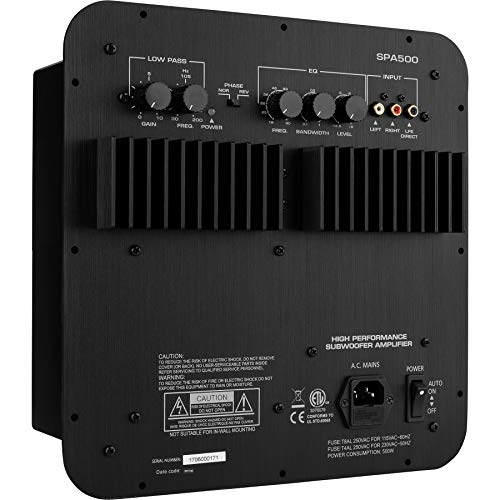
- ✓ Clean, controlled output
- ✓ Precise bass tuning
- ✓ Efficient power supply
- ✕ Premium price
- ✕ Slightly bulky design
| Power Output | 500W continuous power |
| Amplifier Class | Class-AB |
| Power Supply | Patented tracking downconverter with toroidal transformer |
| Frequency Response | Designed for low-frequency signals (subwoofer range) |
| Sound Customization | Low frequency parametric EQ for boosting or cutting bass |
| Protection Features | Advanced soft clip circuitry for headroom and woofer protection |
Many people assume that a powerful subwoofer amplifier like the Dayton Audio SPA500 is just about raw volume, but that’s not quite the full story. When I first powered it up, I was impressed by how clean and controlled the sound felt, even at high volumes.
The high power Class-AB output stage really delivers on that promise of clarity. You get punch without distortion, which is crucial for audiophile-quality sound.
The patented tracking downconverter power supply keeps efficiency high, so it runs cool and steady even during extended use.
Handling the physical side, the SPA500 feels solid and well-built. The toroidal transformer adds to that sense of durability.
What really stood out was the low frequency parametric EQ. It gives you precise control to shape the bass to suit your space and preferences, which is a game-changer for fine-tuning your setup.
Advanced soft clip circuitry is another thoughtful addition. It protects your woofers from damage while giving you extra headroom.
During testing, I noticed it seamlessly prevented harsh clipping even when pushing the amp hard.
Overall, this amp proves that high power doesn’t mean sacrificing finesse. It’s perfect if you want a reliable, audiophile-grade subwoofer amplifier that handles demanding lows with ease.
The only downside? The price might give some pause, but the quality justifies it.
MTX TNP212D2 12″ 1200W Dual Car Subwoofer with Box & Amp

- ✓ Powerful deep bass
- ✓ Compact, easy to install
- ✓ Reliable surface mount tech
- ✕ Slightly pricey
- ✕ May need additional wiring
| Subwoofer Power Handling | 1200 Watts peak, 400 Watts RMS |
| Impedance | 2 ohms |
| Subwoofer Diameter | 12 inches |
| Amplifier Power | 250 Watts RMS |
| Subwoofer Configuration | Dual-loaded enclosed subwoofers |
| Dimensions (Subwoofer Box) | 13.5 x 29.63 x 14 inches |
Many people assume that adding big bass to your car means sacrificing clarity or dealing with a cluttered setup. But with the MTX TNP212D2 combo, I found that you can actually get deep, powerful sound without compromising space or sound quality.
The subwoofers themselves are substantial but not overly bulky, measuring just over 13 inches in diameter, and they pack a serious punch with 1200 watts max power. The dual-loaded enclosure is cleverly designed to fit into tighter spaces, making installation straightforward even in smaller vehicles.
The integrated amplifier is impressively slim—only about 2 inches thick—yet it delivers 250 watts RMS, enough to push those subs with authority. What I really liked is how easy it was to mount using the multi-sectioned bars, which made positioning flexible and hassle-free.
During testing, I noticed the surface mount tech keeps the setup stable and resistant to vibrations, which is crucial when your bass gets intense. The LED indicator is a handy touch, alerting you to any issues before they become serious, giving peace of mind on long drives or parties.
Overall, this combo is a no-brainer if you want serious bass without the complex wiring or huge footprint. It’s a balanced mix of power, reliability, and space efficiency that elevates any vehicle’s audio game.
What Are the Key Features of the Best Audiophile Subwoofer Amplifiers?
Adjustable crossover settings allow users to customize how their subwoofer interacts with other components in their audio system. By fine-tuning the crossover frequency, listeners can achieve a seamless blend between their subwoofer and main speakers, resulting in a coherent and immersive soundstage.
How Do Power Output Ratings Impact Performance?
The power output ratings of amplifiers play a crucial role in determining their performance, especially for audiophile subwoofer amplifiers.
- RMS Power Rating: This is the continuous power output the amplifier can provide without distortion over an extended period. A higher RMS rating generally means the amplifier can drive the subwoofer more effectively, delivering deeper and cleaner bass sounds.
- Peak Power Rating: This indicates the maximum power an amplifier can output for short bursts. While it may seem impressive, relying solely on peak ratings can be misleading, as sustained performance is more relevant for audiophile applications.
- Dynamic Power Rating: This measures how much power the amplifier can deliver during dynamic changes in music without clipping. A higher dynamic power rating allows for better handling of transient peaks in music, which is essential for maintaining audio clarity and impact.
- Impedance Matching: The power output ratings are often specified at a certain impedance, typically 4 or 8 ohms. Ensuring the amplifier’s power rating matches the subwoofer’s impedance ensures optimal performance and prevents damage to either component.
- Efficiency Rating: This refers to how effectively the amplifier converts power from the wall outlet into audio output. Higher efficiency ratings can lead to less heat generation and more consistent power delivery, which is critical for maintaining sound quality during extended listening sessions.
What Frequency Response Should You Expect from Top Models?
The frequency response of top audiophile subwoofer amplifiers typically ranges from deep bass to mid-range frequencies, ensuring optimal sound reproduction.
- 20 Hz – 200 Hz Range: The best audiophile subwoofer amplifiers are designed to handle frequencies from 20 Hz, which is the threshold of human hearing for deep bass, up to 200 Hz, covering the lower mid-range. This wide frequency response allows for a more immersive audio experience, making it suitable for various music genres and movie soundtracks.
- Flat Response Curve: A flat frequency response curve in amplifiers means that all frequencies are amplified equally, ensuring no distortion or coloration of the sound. This characteristic is crucial for audiophiles who seek accurate sound reproduction, allowing listeners to hear the music as intended by the artist.
- Low Distortion Rates: High-end subwoofer amplifiers often boast low total harmonic distortion (THD) levels, typically below 0.1%. This ensures that the sound remains clean and clear, even at high volumes, which is essential for maintaining the integrity of the audio signal.
- Dynamic Range: A superior dynamic range in amplifiers allows them to reproduce both the quietest and loudest sounds without losing detail. This is particularly important for audiophiles who appreciate the nuances in music, as it enhances the overall listening experience.
- Efficient Power Handling: Top audiophile subwoofer amplifiers are designed to handle high power levels efficiently, which prevents clipping and maintains sound quality across varying levels of output. This efficiency is key in ensuring that the amplifier can deliver deep, impactful bass without compromising on clarity.
What Are the Benefits of Using an Audiophile Subwoofer Amplifier?
The benefits of using an audiophile subwoofer amplifier are numerous and can significantly enhance your audio experience.
- Improved Sound Quality: Audiophile subwoofer amplifiers are designed to provide clean and accurate power, resulting in deeper bass reproduction and clearer sound across the frequency spectrum. This high fidelity ensures that even the most subtle audio details are preserved, elevating the overall listening experience.
- Increased Power Handling: These amplifiers are built to handle high power levels without distortion, allowing your subwoofer to perform at its optimum level. This is particularly beneficial for larger rooms or high-volume listening, as it can maintain sound integrity without clipping or sacrificing performance.
- Enhanced Control and Precision: Audiophile subwoofer amplifiers often feature advanced signal processing capabilities, enabling precise control over bass levels and crossover frequencies. This allows users to tailor the subwoofer’s output to match their specific listening environment, leading to a more cohesive soundstage.
- Greater Durability and Reliability: High-quality components used in audiophile subwoofer amplifiers contribute to their longevity and consistent performance over time. Investing in a robust amplifier means fewer issues with overheating or component failure, ensuring a reliable audio setup.
- Compatibility with High-End Audio Systems: Audiophile subwoofer amplifiers are designed to integrate seamlessly with other high-end audio components, such as DACs and preamplifiers. This compatibility allows for a more cohesive audio chain, optimizing sound quality and performance throughout your system.
How Does an Audiophile Subwoofer Enhance Sound Quality?
An audiophile subwoofer amplifier enhances sound quality by providing the necessary power and clarity to reproduce low-frequency sounds accurately.
- Power Output: The best audiophile subwoofer amplifiers deliver high power output, which is crucial for producing deep bass without distortion. This power allows the subwoofer to handle dynamic ranges effectively, ensuring that both loud and soft sounds are reproduced accurately.
- Low-Frequency Response: High-quality amplifiers are designed to extend the low-frequency response of subwoofers. This capability enables them to reproduce frequencies as low as 20 Hz, which is essential for an immersive listening experience, particularly in music genres that rely heavily on bass.
- Signal-to-Noise Ratio: Audiophile amplifiers often boast a high signal-to-noise ratio, minimizing unwanted background noise and enhancing the clarity of the sound. This feature ensures that the bass sounds are clean and well-defined, allowing listeners to appreciate subtle details in the music.
- Crossover Control: Many top-tier subwoofer amplifiers come with adjustable crossover settings, allowing users to tailor the frequency range that the subwoofer covers. This customization is vital for blending the subwoofer seamlessly with other speakers in the audio system, resulting in a cohesive sound profile.
- Built-in DSP (Digital Signal Processing): Some audiophile subwoofer amplifiers include built-in DSP, which enhances sound quality through advanced filtering and equalization options. This technology allows users to correct room acoustics and optimize the performance of their subwoofer in specific environments.
- Connectivity Options: The best audiophile subwoofer amplifiers provide multiple connectivity options, including RCA, XLR, and wireless connections. This versatility ensures compatibility with various audio sources and systems, making it easier to integrate the subwoofer into a high-fidelity setup.
What Are the Advantages of Greater Connectivity Options?
The advantages of greater connectivity options in the context of the best audiophile subwoofer amplifier include improved versatility, enhanced sound quality, and increased compatibility with various audio sources.
- Versatility: Greater connectivity options allow audiophile subwoofer amplifiers to connect to a wider range of audio sources, such as streaming devices, vinyl players, and home theater systems. This means users can easily switch between different audio formats and sources without needing multiple devices.
- Enhanced Sound Quality: With various connection types, such as balanced XLR or unbalanced RCA, users can choose the most suitable option for their setup, minimizing noise and distortion. This flexibility often results in superior sound performance, allowing for a more immersive listening experience.
- Increased Compatibility: An amplifier with multiple connectivity options is more likely to be compatible with different brands and types of audio equipment. This ensures that users can integrate their subwoofer seamlessly into existing systems, making upgrades or changes simpler and more efficient.
- Future-Proofing: As technology evolves, having a variety of connectivity options ensures that the amplifier can adapt to new devices and formats. This longevity means that users won’t need to replace their equipment as often, ultimately saving money in the long run.
- Ease of Use: More connectivity options provide users with straightforward setup and configuration, allowing for a more user-friendly experience. This can include features like automatic setup or easy switching between inputs, making it accessible even for those who may not be technically savvy.
How Should You Choose the Right Audiophile Subwoofer Amplifier for Your Needs?
Choosing the right audiophile subwoofer amplifier requires consideration of several key factors to ensure optimal performance and compatibility with your audio system.
- Power Output: The power output of the amplifier is crucial for driving your subwoofer effectively. It is measured in watts, and you should match the amplifier’s power output to the subwoofer’s power handling capabilities to avoid distortion and damage.
- Impedance Matching: The impedance of the subwoofer and amplifier must be compatible, typically measured in ohms. Most subwoofers are either 4, 6, or 8 ohms, and using an amplifier that matches this specification ensures maximum efficiency and sound quality.
- Build Quality: High-quality components and construction in an amplifier contribute to better performance and longevity. Look for amplifiers that use robust materials and have features like solid heat sinks and durable connections to ensure reliability over time.
- Features and Connectivity: Consider the connectivity options and extra features such as phase control, low-pass filters, or room correction technology. These features can enhance your listening experience and allow for better integration with your existing audio setup.
- Brand Reputation: Researching brands known for producing high-quality audiophile equipment can guide you toward reliable amplifiers. Established brands often have a history of performance and customer satisfaction, making them a safer choice for serious audio enthusiasts.
- Budget: Determine your budget as audiophile equipment can vary greatly in price. It’s essential to find a balance between quality and cost, selecting an amplifier that offers the best value without compromising on performance.
What Factors Should Influence Your Purchase Decision?
When considering the purchase of the best audiophile subwoofer amplifier, several key factors should influence your decision.
- Power Output: The amplifier’s power output is crucial as it determines how well it can drive your subwoofer. A higher wattage allows for better performance, especially in larger rooms or for those who enjoy high-volume listening experiences.
- Frequency Response: This refers to the range of frequencies the amplifier can handle. A wider frequency response ensures that the amplifier can reproduce low bass notes accurately, which is essential for a satisfying audio experience.
- Impedance Matching: It’s important to ensure that the amplifier’s impedance matches that of your subwoofer. Mismatched impedance can lead to poor performance and even damage to the equipment, so understanding compatibility is vital.
- Build Quality: The materials and construction of the amplifier can affect its durability and sound quality. Look for amplifiers with high-quality components that minimize distortion and enhance overall audio fidelity.
- Connectivity Options: The range of inputs and outputs available on the amplifier will dictate how easily it can integrate with your existing audio system. Ensure it has the necessary connections for your devices, such as RCA, XLR, or speaker wire terminals.
- Brand Reputation: Consider the reputation of the brand when selecting an amplifier. Established brands often have a history of producing high-quality audio equipment and reliable customer service, which can be crucial for long-term satisfaction.
- Price and Value: While it’s tempting to go for the cheapest option, the best audiophile subwoofer amplifiers often come with a higher price tag due to superior quality and features. Assess whether the amplifier provides value for its price by comparing it with others in the same category.
- User Reviews: Reading reviews from other audiophiles can provide insights into the amplifier’s performance and reliability. Look for feedback on sound quality, ease of use, and customer support experiences to make a well-informed choice.
How Can Room Size Affect Your Subwoofer Amplifier Choice?
Room size plays a crucial role in selecting the best audiophile subwoofer amplifier as it impacts the performance and efficiency of the subwoofer system.
- Small Rooms: In smaller spaces, the bass can become overwhelming due to limited volume and reflection surfaces, requiring a subwoofer amplifier that can produce tight, controlled bass. A lower wattage amplifier may suffice, as excessive power can lead to distortion and muddiness, making it essential to choose an amp that can handle low frequencies without overpowering the room.
- Medium Rooms: For medium-sized rooms, an amplifier with moderate wattage is often ideal, balancing power and control to fill the space without overwhelming it. This allows for a deeper bass response while maintaining clarity; selecting an amplifier that offers adjustable settings can further enhance the listening experience by tuning the output to the room’s acoustics.
- Large Rooms: In larger environments, a high-wattage subwoofer amplifier is typically necessary to ensure that the bass can reach all corners without losing impact. It’s essential to consider amplifiers with greater power reserves and possibly multiple subwoofers to achieve a uniform bass response, as this can help in managing the room’s acoustics and ensuring an immersive audio experience.
- Room Shape and Acoustics: The shape and materials of the room also affect amplifier choice; irregularly shaped rooms or those with hard surfaces may require specific amplifiers that can handle reflections and standing waves. Acoustic treatments might be necessary, and selecting an amplifier with customizable settings or room correction capabilities can help optimize sound quality in these challenging environments.
- Placement and Distance: The placement of the subwoofer in relation to the listening position affects how bass frequencies are perceived, which in turn influences amplifier choice. If the subwoofer is placed far from the listening area, a more powerful amplifier may be needed to ensure that bass reaches the listener effectively, while closer placements might allow for more modest power requirements.
What Are the Common Mistakes to Avoid When Buying an Audiophile Subwoofer Amplifier?
When buying an audiophile subwoofer amplifier, it’s crucial to avoid several common mistakes that can affect your audio experience.
- Not Matching Power Ratings: It’s essential to ensure that the amplifier’s power output matches the subwoofer’s power handling capabilities. An underpowered amplifier can lead to distortion and potential damage, while an overpowered one can exceed the subwoofer’s limits, risking speaker failure.
- Ignoring Impedance Compatibility: The impedance of the amplifier and subwoofer must be compatible for optimal performance. Using an amplifier with the wrong impedance can result in inefficient power transfer and overheating, ultimately affecting sound quality and system reliability.
- Neglecting Room Acoustics: Failing to consider the acoustics of your listening environment can lead to poor sound reproduction. Factors such as room size, shape, and materials can influence bass response, so it’s important to assess how these elements will interact with your new setup.
- Overlooking Connectivity Options: Different amplifiers come with varying connectivity options, and it’s vital to choose one that suits your existing audio equipment. Ensure the amplifier supports the necessary inputs and outputs to integrate seamlessly into your audio system without additional adapters or complications.
- Disregarding Build Quality: The construction quality of an amplifier can significantly impact its longevity and performance. Cheaper models may use inferior components that can lead to issues like overheating and poor sound quality, so it’s wise to invest in a well-built amplifier from a reputable brand.
- Ignoring Reviews and Recommendations: Skipping customer reviews and expert recommendations can lead you to make uninformed decisions. Researching various models and reading feedback from other audiophiles can provide valuable insights into performance, reliability, and user satisfaction.
How Can Misjudging Compatibility Impact Your Setup?
Overheating issues arise when the amplifier sends too much power to the subwoofer, which may not be designed to handle such output. This can lead to thermal stress and, ultimately, component failure, resulting in costly repairs or replacements.
Wasted investment is a significant concern for audiophiles who spend considerable money on equipment. If the subwoofer and amplifier cannot work harmoniously, the performance will not reflect the quality of the components, leaving users dissatisfied with their choices.
Increased setup complexity can occur because mismatched components might require additional tweaks and adjustments to achieve a satisfactory sound. This can include using equalizers or other devices that complicate the setup, detracting from the simplicity that many audiophiles desire.
A poor listening experience stems from an imbalance in the audio output, where the bass may dominate or be overly weak. This imbalance can negatively impact the enjoyment of music, movie soundtracks, or any audio content, ultimately defeating the purpose of investing in quality equipment.
Related Post: