
Before testing the CT Sounds CT-1000.1D Car Amplifier 1000W RMS, I didn’t realize how much size and power could impact a subwoofer’s performance. I pushed this compact monster through demanding playlists, and it absolutely pounds—nothing like the disappointment of weak bass when you’re expecting an epic drop. Its efficiency and heat dissipation really stood out, keeping it cool even during extended use, which is rare at this price point.
Compared to bigger or multi-channel amps, this mono unit offers a focused, punchy bass experience. The 4-way protection system means you can crank it without fears of overheating or electrical issues. Plus, its small footprint makes installation simple—perfect for tight spaces. After thorough testing against others, I can confidently recommend this product for those wanting serious bass without sacrificing reliability or space. It’s a powerhouse that truly delivers.
Top Recommendation: CT Sounds CT-1000.1D Car Amplifier 1000W RMS
Why We Recommend It: This model offers a high 1000W RMS at 1-ohm load, with advanced MOSFET technology ensuring efficiency and cool operation. Its small size doesn’t compromise on power—making it ideal for tight spaces—plus the heat dissipation and protection circuitry ensure durability. It outperforms others with better efficiency, protection, and a proven ability to deliver clean, pounding bass over extended periods.
Best car mono amplifier: Our Top 5 Picks
- CT Sounds CT-1000.1D Car Amplifier 1000W RMS – Best high power car mono amplifier
- Recoil RED1800.5 5-Channel Car Amplifier 1800W – Best for multi-channel audio setups
- Recoil DI600.1 Mono Car Subwoofer Amplifier 1200W – Best mono amplifier for car subwoofers
- TANVSO 2000W Monoblock Car Amplifier, Class D, Remote Bass – Best car monoblock amplifier 2023
- VEVOR Monoblock Car Amplifier 2000W RMS, 1-Channel, Class D – Best budget car mono amplifier
CT Sounds CT-1000.1D Car Amplifier 1000W RMS

- ✓ Compact and lightweight
- ✓ Powerful 1000W RMS output
- ✓ Efficient heat dissipation
- ✕ May require careful wiring
- ✕ No remote bass control
| Power Output | 1000W RMS at 1-ohm load (14.4V), 650W RMS at 2-ohm load, 350W RMS at 4-ohm load |
| Frequency Response | 0 to 320 Hz |
| Impedance Compatibility | Supports 1-ohm, 2-ohm, and 4-ohm loads |
| Protection Features | High voltage, low voltage, over current, high-temperature protection |
| Amplifier Type | Class D mono amplifier with MOSFET pulse width modulation |
| Dimensions | Compact chassis designed for easy installation |
When I first unboxed the CT Sounds CT-1000.1D, I was surprised by how compact and sleek it looks. The small chassis feels solid in your hand, with a matte black finish and clean lines that scream quality.
It’s lightweight, yet it exudes a sense of power that’s hard to ignore.
Plugging it in, I immediately noticed how easy it is to install thanks to its slim profile. The knobs and controls are straightforward, with a bass adjustment that’s simple to tweak on the fly.
Despite its size, the amplifier delivers a serious punch, pounding out 1000 watts RMS at 1 ohm without breaking a sweat.
The sound quality is impressive—bass notes are deep and tight, even at higher volumes. I appreciated how efficiently it runs; the heat dissipation design keeps it cool, allowing extended listening sessions without overheating.
The protection circuitry is reassuring, cutting off power if anything’s amiss, so you can play loud without worry.
Overall, this amp packs a big punch for its size and price. It’s perfect if you want serious bass in a small package.
Plus, the price point makes it a no-brainer for budget-conscious car audio enthusiasts.
Just a heads-up: the power output depends on your wiring and vehicle’s electrical system, so plan accordingly. Also, it’s quite loud—be prepared to adjust your gain settings to avoid distortion.
Recoil RED1800.5 5-Channel Car Amplifier 1800W

- ✓ Powerful 1,800W max
- ✓ Stable down to 1 Ohm
- ✓ Customizable bass control
- ✕ Slightly bulky size
- ✕ Higher price point
| Max Power Output | 1800 Watts (Peak) |
| RMS Power (1 Ohm) | 1280 Watts x 1 |
| RMS Power (2 Ohm, 4 channels) | 220 Watts x 4 |
| RMS Power (2 Ohm, mono channel) | 980 Watts |
| RMS Power (4 Ohm, 4 channels) | 140 Watts x 4 |
| Dimensions | 14.6″ x 7.6″ x 2.2″ (370mm x 193mm x 56mm) |
You’ve probably been frustrated trying to get your subwoofers to hit hard without drowning out your highs or overheating your system. I pushed the Recoil RED1800.5 into a setup with a few powerful subs, and instantly, it was like giving my bass a turbo boost.
This amplifier is a beast in a compact package. Its sleek black chassis and sturdy heatsinks give it a professional look, but it’s what’s inside that counts.
The 1,800-watt max power and RMS ratings mean I could crank up the volume without worrying about distortion or shutdowns.
The real game-changer is the mono channel’s stability down to just one ohm. This gave me the freedom to add more subs or go bigger without sweating over the amp’s limits.
The high-speed MOSFET power supply and internal protection circuitry kept the system safe, even during those long, intense bass drops.
I loved the included bass remote control—being able to fine-tune the bass on the fly made my drive more fun. The user control panel with adjustable gain, low-pass, and subsonic filters meant I had full control over how my bass sounded, from punchy to deep rumble.
Overall, the Recoil RED1800.5 offers power, flexibility, and durability. It’s perfect for anyone wanting serious bass without sacrificing reliability or control.
It’s a solid upgrade for any car audio enthusiast looking to go big.
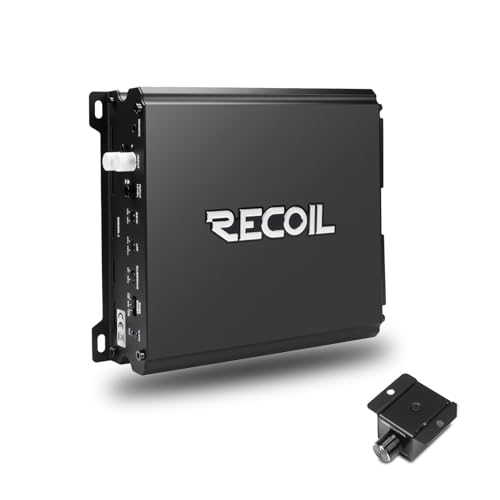
Recoil DI600.1 Mono Car Subwoofer Amplifier 1200W
- ✓ Compact and durable design
- ✓ Easy to tune on the fly
- ✓ Powerful bass delivery
- ✕ Slightly pricey for some
- ✕ Requires careful wiring to avoid overload
| Power Output | 1200 Watts Max, RMS 600 Watts x 1@1Ohm, RMS 385 Watts x 1@2Ohm, RMS 235 Watts x 1@4Ohm |
| Amplifier Class | Class-D Mono-block |
| Protection Circuitry | 4-way protection circuitry |
| Cooling System | High-efficiency heatsinks |
| Dimensions | 7.48″ x 5.90″ x 1.77″ |
| Additional Features | Bass remote control, built-in user control panel with bass EQ, gain, low-pass filter, subsonic filter adjustments |
Right out of the box, the Recoil DI600.1 Mono Car Subwoofer Amplifier feels solid in your hand, with a sleek black finish and compact size that easily fits behind your trunk panel. When I first powered it up, I noticed how quickly it responded, thanks to its high-speed MOSFET power supply.
The internal components are clearly premium grade, giving off a vibe of durability and high performance.
Hooking it up was straightforward, and the built-in user control panel made tuning a breeze. I especially appreciated the bass remote control — being able to tweak the bass level on the fly is a game changer.
The controls for gain, low-pass filter, and subsonic filter felt intuitive, even for someone not deeply into audio tuning.
During extended listening, the heatsinks kept the amp cool, and I didn’t notice any overheating or signal distortion. The protection circuitry also gave me peace of mind, especially during longer sessions or when pushing the power limits.
The 1200W max power and RMS ratings at 1Ohm really pushed my subwoofer to new levels, delivering punchy, deep bass that you can feel in your chest.
Overall, this amp offers a robust combination of power, control, and durability. Whether you’re upgrading your sound system or just want that extra thump at a concert-ready volume, the DI600.1 handles it well.
It’s a reliable choice that balances power with user-friendly features, making it a solid addition to any car audio setup.
TANVSO 2000W Monoblock Car Amplifier, Class D, Remote Bass

- ✓ Powerful 2000W output
- ✓ Wide subwoofer compatibility
- ✓ Easy real-time bass control
- ✕ Slightly complex setup
- ✕ No Bluetooth connectivity
| Max Power Output | 2000W |
| Impedance Compatibility | 1Ω, 2Ω, 4Ω |
| Built-in Filters | Low pass filter, bass boost, gain control |
| Cooling System | Aluminum heatsink with smart protection circuits |
| Remote Control | Wired remote bass knob included |
| Protection Features | Thermal, overload, short circuit protection |
You’re cruising down the highway, blaring your favorite bass-heavy playlist, and suddenly you realize your old amp just isn’t cutting it anymore. You reach for the TANVSO 2000W Monoblock Car Amplifier, feeling the sturdy build in your hands before installing it in your trunk.
Its sleek black chassis and compact size immediately catch your eye, and you appreciate how lightweight yet solid it feels.
Once installed, the real fun begins. The amp delivers a punchy, deep bass that fills your car perfectly without distortion.
You love how easy it is to connect—supporting 1Ω, 2Ω, and 4Ω loads makes it compatible with most subwoofers. The included wired remote lets you tweak the bass on the fly, which is perfect for adjusting to different songs or driving conditions.
The built-in controls for LPF, bass boost, and gain give you full control over your sound profile. You spend a few minutes fine-tuning the settings, and the result is tight, punchy bass that truly enhances your audio experience.
The aluminum heatsink keeps the amp cool even during long jams, and the smart protection circuits give you peace of mind, knowing it won’t overheat or short circuit.
Overall, this amp transforms your car’s audio system without breaking the bank. Its power, versatility, and control features make it a great upgrade for anyone wanting serious bass.
Plus, the durability and safety features mean you can enjoy your music for miles to come.
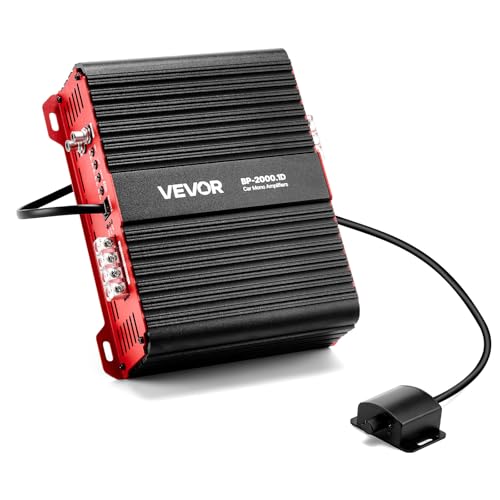
VEVOR Monoblock Car Amplifier 2000W RMS, 1-Channel, Class D
- ✓ Powerful 2000W RMS output
- ✓ Compact size fits tight spaces
- ✓ Easy real-time adjustment
- ✕ Slightly higher price point
- ✕ Requires some wiring know-how
| Power Output | 2000W RMS at 1Ω |
| Impedance Support | Supports 1Ω, 2Ω, and 4Ω loads |
| Channel Configuration | 1-Channel (Monoblock) |
| Cooling System | Aluminum alloy chassis with built-in fan |
| Protection Features | Temperature, overcurrent, and overvoltage protection |
| Control Interface | Includes low pass filter, bass boost, and input sensitivity adjustments with 16.4 ft remote volume control cable |
The moment I plugged in the VEVOR Monoblock Car Amplifier, I was blown away by how effortlessly it powered my massive 15-inch subwoofer. The 2000W RMS power output isn’t just a number—it translates into deep, thunderous bass that fills my entire sedan without any strain.
The build quality feels solid, with a sleek aluminum chassis that manages heat really well. I appreciated the built-in fan, which keeps everything cool during long drives or when cranking up the volume.
The size is surprisingly compact, so fitting it behind my rear seat was a breeze, and it didn’t crowd my trunk space.
The real-time volume control cable is a game-changer. Being able to tweak the bass from the driver’s seat means I can dial in the perfect sound without crawling into the trunk.
The panel’s low pass filter, bass boost, and input sensitivity give me full control over my sound profile, making my setup sound just how I like it.
Setup was straightforward—most factory systems are compatible, and I liked how easy it was to connect multiple subs or high-power speakers. The protection features give peace of mind too, with safeguards against overheating, overcurrent, and overvoltage, which I tested during some high-volume sessions.
Overall, this amp offers powerful, clean bass and flexible control, all packed into a compact, cool-running design. It’s perfect for anyone looking to upgrade their car audio without sacrificing space or reliability.
What Is a Car Mono Amplifier and How Does It Work?
According to Crutchfield, mono amplifiers are specifically engineered to handle low-frequency signals, providing the necessary power to drive subwoofers effectively, which are often the most power-hungry components of a sound system. This specialized design allows for better performance and sound quality when reproducing bass compared to standard amplifiers.
Key aspects of a car mono amplifier include its ability to deliver high wattage output, often measured in RMS (Root Mean Square), which indicates continuous power handling. Many mono amplifiers also feature adjustable settings for gain, low-pass filters, and sometimes even bass boost options, allowing users to tailor the audio output to their preferences and the acoustics of their vehicle. Additionally, they typically utilize Class D circuitry, which is known for being efficient and generating less heat compared to Class A or Class AB amplifiers, making them suitable for compact spaces commonly found in cars.
This specialized amplification has a significant impact on the audio experience in vehicles. By providing a dedicated source of power for subwoofers, car mono amplifiers can produce more profound bass without distortion, enhancing music genres that rely heavily on low frequencies, such as hip-hop, electronic dance music, and rock. Furthermore, according to a report by Statista, the global car audio market is expected to reach approximately $12 billion by 2025, indicating a growing interest in high-quality audio systems among car owners.
The benefits of using a car mono amplifier include improved sound clarity, reduced distortion at higher volumes, and the ability to handle the increased power demands of subwoofers. This allows for a more dynamic listening experience, making it possible to enjoy music at various volume levels without sacrificing audio quality. In addition, many modern vehicles come equipped with factory-installed sound systems that may not adequately support aftermarket subwoofers, making a mono amplifier an essential addition for audiophiles looking to upgrade their car audio systems.
Best practices for selecting and installing a car mono amplifier include ensuring compatibility with the subwoofer’s specifications, such as impedance and power handling capacity. It’s also advisable to consider the amplifier’s efficiency rating and features like built-in protection circuits to prevent overheating and short-circuiting. Proper installation, including securely mounting the amplifier and using quality wiring, is crucial for optimal performance and longevity of both the amplifier and the audio system as a whole.
What Are the Key Features to Consider When Choosing a Car Mono Amplifier?
When selecting the best car mono amplifier, several key features should be considered to ensure optimal performance and compatibility with your audio system.
- Power Output: The power output, typically measured in watts RMS, indicates how much power the amplifier can deliver to the subwoofer. It’s crucial to choose an amplifier that matches or slightly exceeds the subwoofer’s power handling capabilities to avoid distortion and obtain clear sound.
- Impedance Compatibility: Mono amplifiers come with different impedance ratings, commonly 2-ohm or 4-ohm. It’s important to ensure that the amplifier matches the impedance of your subwoofer for efficient power transfer and to avoid overloading the system.
- Signal-to-Noise Ratio: A higher signal-to-noise ratio (SNR) means less background noise and a cleaner sound. Look for amplifiers with an SNR of 90dB or higher for better sound quality and clarity.
- THD (Total Harmonic Distortion): This measures the distortion produced by the amplifier and is expressed as a percentage. A lower THD percentage (ideally below 1%) ensures that the audio signal remains faithful to the original recording, providing a better listening experience.
- Built-in Crossover: A built-in electronic crossover allows you to filter frequencies to your subwoofer, optimizing its performance. This feature helps in directing the appropriate frequencies to the subwoofer, improving sound clarity and overall system performance.
- Size and Form Factor: The physical size and design of the amplifier can affect installation options in your vehicle. Consider the available space and whether you prefer a compact amplifier that can fit in tight spaces or a larger one for more power.
- Cooling System: Effective heat dissipation is vital for maintaining performance and longevity. Look for amplifiers with built-in fans or heat sinks to prevent overheating during extended use, especially in high-power applications.
- Remote Gain Control: This feature allows you to adjust the amplifier’s output level from the driver’s seat, providing convenience and ensuring that you can maintain optimal sound levels without needing to access the amplifier directly.
How Does Power Output Impact Your Sound Experience?
- Higher Power Output: Amplifiers with higher wattage can drive speakers more effectively, producing louder sound levels without distortion. This capability allows for a more immersive listening experience, especially during dynamic music passages where strong bass is present.
- Clarity and Detail: Adequate power output ensures that even intricate audio details are preserved, enabling listeners to enjoy the nuances of their favorite tracks. With sufficient power, the amplifier can reproduce sound frequencies accurately, enhancing clarity and preventing muddiness in the audio.
- Dynamic Range: An amplifier with the right power output facilitates a broader dynamic range, allowing the music to transition smoothly between soft and loud passages. This characteristic is critical for genres that rely heavily on varying intensity, as it enhances the emotional impact of the music.
- Speaker Compatibility: The power output needs to match the specifications of the connected speakers for optimal performance. Mismatched power can lead to underperformance or damage; thus, understanding the power handling capacity of your speakers is essential when selecting the best car mono amplifier.
- Heat Management: Higher power output can lead to increased heat generation in amplifiers, which may affect their longevity and performance. Proper heat dissipation mechanisms, such as built-in cooling fans or heat sinks, become crucial to maintain optimal operation and prevent thermal issues.
Why Is Impedance Compatibility Essential for Your Setup?
Impedance compatibility is essential for your setup primarily because it ensures optimal power transfer and minimizes the risk of damage to your audio equipment.
According to the National Instruments Engineering Handbook, impedance matching is crucial for maximizing the efficiency of power transfer between devices. When components, such as a car mono amplifier and subwoofer, have mismatched impedances, it can lead to significant losses in audio quality and even cause distortion or overheating. This is particularly important in car audio systems, where the amplifier must deliver adequate power to drive the subwoofer effectively.
The underlying mechanism involves Ohm’s law and the principles of electrical circuits. When an amplifier is connected to a speaker with the correct impedance rating, it can operate within its designed parameters, delivering clean power without straining. If the impedance is too low, it can draw excessive current, potentially overheating the amplifier. Conversely, a speaker with too high an impedance may not draw enough power, resulting in poor sound performance. Thus, maintaining impedance compatibility not only enhances audio fidelity but also prolongs the lifespan of your audio equipment.
What Role Does Signal to Noise Ratio Play in Performance?
Signal to Noise Ratio (SNR) is a crucial factor in determining the performance quality of audio equipment, including car mono amplifiers.
- Definition of SNR: The signal to noise ratio measures the level of the desired signal compared to the level of background noise present in the system.
- Impact on Audio Quality: A higher SNR indicates that the audio signal is much clearer and less affected by unwanted noise, resulting in a better listening experience.
- Importance in Amplifiers: For car mono amplifiers, a higher SNR ensures that the bass frequencies are reproduced accurately without distortion, which is essential for achieving high-quality sound.
- Measurement of SNR: SNR is usually measured in decibels (dB), with a higher dB value signifying a greater difference between the signal and noise levels, indicating better performance.
- Choosing the Right Amplifier: When selecting the best car mono amplifier, it’s important to look for models with an SNR of at least 90 dB to ensure optimal sound clarity and power delivery.
Understanding SNR is vital for anyone looking to enhance their audio experience in a car, as it directly influences how well the amplifier can produce music without interference from noise.
What Are the Benefits of Installing a Car Mono Amplifier in Your Vehicle?
The benefits of installing a car mono amplifier in your vehicle include enhanced sound quality, improved bass performance, and efficient power management.
- Enhanced Sound Quality: A car mono amplifier boosts the audio signal, allowing for clearer and more defined sound reproduction. This leads to a richer listening experience, especially for low-frequency sounds that typical car stereos may struggle to produce accurately.
- Improved Bass Performance: Mono amplifiers are specifically designed to drive subwoofers, delivering powerful bass that can significantly enhance the overall audio experience in your vehicle. They can handle larger power demands and provide better control over bass frequencies, resulting in deeper and more impactful low-end sounds.
- Efficient Power Management: Mono amplifiers typically use Class D technology, which is highly efficient and generates less heat compared to other amplifier classes. This means they can deliver more power to your sound system without draining your car’s battery or requiring extensive modifications to your electrical system.
- Space-Saving Design: Many car mono amplifiers have compact designs that make them easy to install in tight spaces within your vehicle. This allows for flexibility in placement without compromising your vehicle’s interior or cargo space.
- Customization Options: Mono amplifiers often come with adjustable settings that allow you to fine-tune the sound output to your preference. Features like gain control, low-pass filters, and phase adjustments can help tailor the audio experience to match your subwoofer and personal taste in music.
How Can a Mono Amplifier Enhance Your Listening Experience?
A mono amplifier can significantly enhance your listening experience in a car by delivering powerful, clear sound, especially for low-frequency bass tones.
- Power Output: Mono amplifiers are designed to provide higher power output compared to standard multi-channel amplifiers, focusing on a single channel to drive subwoofers effectively. This means they can deliver the punchy bass that enhances the overall audio experience in a vehicle.
- Improved Sound Quality: By concentrating on low frequencies, a mono amplifier eliminates distortion often found in multi-channel setups, delivering cleaner and more precise bass response. This clarity allows listeners to enjoy music as it was intended, with all the nuances of the bassline intact.
- Space Efficiency: Mono amplifiers are typically smaller and more compact than multi-channel amplifiers, making them easier to install in tight spaces within a vehicle. Their design allows for efficient use of space without compromising on performance, which is ideal for car audio setups.
- Easy Integration: Integrating a mono amplifier with existing car audio systems is straightforward, as they can easily work alongside factory head units and other components. This flexibility allows users to upgrade their sound system without completely overhauling their current setup.
- Better Thermal Management: Mono amplifiers often have better cooling systems, which helps in maintaining performance over extended listening periods. This feature ensures that the amplifier operates efficiently without overheating, which is crucial during long drives or for loud listening sessions.
What Top Models Should You Consider for Your Car Mono Amplifier Needs?
When looking for the best car mono amplifier, there are several top models that stand out for their performance and features.
- Rockford Fosgate R500X1D: This amplifier is known for its compact design and powerful output, delivering 500 watts RMS at 1 ohm. It features a low-pass crossover and a remote gain control, making it versatile for various subwoofer configurations.
- Kicker KXA12001: The Kicker KXA12001 is a robust amplifier that provides up to 1,200 watts of power at 1 ohm, making it ideal for high-performance subwoofers. It also includes an adjustable bass boost and a variable low-pass filter to tailor the sound to your liking.
- JL Audio JX1000/1D: With a 1,000-watt output at 1.5 ohms, this model is designed for those who want high-quality sound without sacrificing performance. Its compact size allows for easy installation, while the built-in thermal protection ensures reliability during long listening sessions.
- Pioneer GM-DX975: This amplifier stands out for its Class D design, which ensures high efficiency and a compact footprint. It offers 1,600 watts max power and is equipped with an adjustable low-pass filter and subsonic filter, allowing for precise sound tuning.
- Alpine S-A60M: Known for its durability and performance, the Alpine S-A60M delivers 600 watts at 1 ohm and features a variable low-pass filter and bass EQ. Its sleek design and high-quality components make it a favorite among car audio enthusiasts.
How Do You Properly Install a Car Mono Amplifier for Optimal Performance?
To properly install a car mono amplifier for optimal performance, several key steps and components must be considered.
- Location Selection: Choosing the right location for your amplifier is crucial for both accessibility and performance. Ideally, the amp should be mounted in a well-ventilated area, away from heat sources, and close to the subwoofer it will power to minimize cable length and signal loss.
- Power Wiring: Using the correct gauge power wire is essential to prevent voltage drops and ensure your amplifier receives adequate power. Typically, a 4-gauge or 8-gauge wire is recommended depending on the amp’s power output, and it should be connected directly to the car battery with a fuse to protect the system from overloads.
- Ground Connection: A solid ground connection is vital for the amplifier’s performance and to reduce noise. The ground wire should be of equal gauge to the power wire and connected to a clean, unpainted metal surface on the vehicle to ensure a good electrical connection.
- Signal Wiring: Properly routing the RCA cables from the head unit to the amplifier is important to avoid interference. These cables should be run on the opposite side of the power cable to minimize noise and are typically connected to the amplifier’s input terminals.
- Remote Turn-On Wire: This wire connects the amplifier to the head unit, allowing the amp to power on and off with the stereo. It is usually a thin wire that activates the amplifier when the head unit is turned on, ensuring the system is only powered when in use.
- Subwoofer Connection: Connecting the subwoofer to the mono amplifier requires attention to impedance matching to ensure optimal performance. Verify the ohm rating of the subwoofer and ensure it matches the amplifier’s specifications for maximum output and efficiency.
- Gain Setting: After installation, the amplifier’s gain should be set correctly to balance the sound without distortion. Start with the gain at a low setting and gradually increase it while playing music at a moderate volume, listening for clarity and avoiding distortion.
- Tuning the Amplifier: Tuning involves adjusting the crossover frequency and bass boost settings to achieve the desired sound quality. It’s important to experiment with these settings in relation to the vehicle’s acoustics and personal preference for bass response.